
Reusable packaging is moving from pilot projects to long-term business strategies across foodservice, sports venues, events, universities, and retail. Driven by evolving regulations, sustainability targets, and growing pressure to reduce waste, organizations are increasingly exploring alternatives to disposable packaging.
The challenge is significant. More than 400 million tons of plastic are produced globally every year, and roughly half is designed to be used only once. Yet less than 10% is recycled. At the same time, millions of tonnes of plastic continue to leak into rivers, lakes, and oceans annually. (Source: United Nations)
As a result, reusable packaging is gaining momentum across foodservice in segments such as Horeca, QSR, sports venues, festivals and events, education, health, and travel catering. But successful reuse is much more than replacing a disposable cup or container. It requires a system that keeps packaging in circulation efficiently, economically, and at scale.

Why Reuse Is Moving Into the Mainstream
Packaging has always played an essential role in protecting products, ensuring food safety, and supporting operational efficiency. However, growing environmental concerns and evolving regulations are prompting organizations to evaluate whether reusable packaging offers a viable alternative.
The scale of the challenge is significant. In the European Union alone, 79.7 million tons of packaging waste were generated in 2023, equivalent to 177.8 kg per person. Plastic packaging accounted for 35.3 kg per resident. (Source: European Commission / Eurostat)
At the same time, legislation is accelerating the transition toward more circular packaging systems. The EU’s Single-Use Plastics Directive focuses on reducing the environmental impact of certain single-use plastic products, while the Packaging and Packaging Waste Regulation introduces broader requirements to reduce packaging waste and increase reuse across the packaging value chain.
For many organizations, reusable packaging is no longer viewed solely as a sustainability initiative. It is increasingly becoming a strategic business consideration driven by operational requirements, regulatory developments, and environmental goals.
Reuse Is About More Than the Packaging
When people discuss reusable packaging, the conversation often focuses on the product itself: a reusable cup, bowl, tray, or food container.
For good reason. The packaging itself plays a critical role in any reuse system. Durability, material selection, stackability, and ease of washing all influence how efficiently products can circulate through multiple use cycles.
However, the product is only one part of the system.
A successful reusable packaging program may involve:
- Packaging manufacturers
- Collection and return infrastructure
- Washing and sanitization partners
- Logistics providers
- Deposit or payment solution providers
- Venue operators and foodservice organizations
- Technology providers supporting tracking and reporting
Each stakeholder plays a role in keeping packaging in circulation through multiple use cycles. Without this broader ecosystem, even the most durable reusable product may struggle to achieve its full potential.
Why Environment Matters
Not every setting is equally suited to reusable packaging.
Controlled environments are often the most straightforward places to implement reuse because products remain within a defined area and can be collected, washed, and redistributed efficiently.
Examples include:
- Stadiums and arenas
- Festivals and events
- University campuses
- Corporate dining facilities
- Theme parks
- Entertainment venues

In these environments, products circulate within a relatively controlled ecosystem, making return behavior easier to manage and operational processes more predictable.
That doesn’t mean reuse cannot work elsewhere. Retail, hospitality, and broader foodservice applications are also exploring reusable models. However, these systems often require greater coordination between multiple stakeholders.
How smart technology adds value
As reusable packaging systems mature, organizations are increasingly exploring digital tools to improve performance and visibility.
That doesn’t mean every reusable system requires RFID chips or QR codes. Many programs operate successfully through simple deposit-and-return models supported by effective collection and washing processes.
However, technology can add value in larger or more complex operations. RFID solutions are often used at stadiums and festivals, where operators need real-time visibility of thousands of products in circulation. QR-code platforms are commonly used in environments such as university campuses, where they help connect users to return and participation programs, and are increasingly appearing at larger events as well.
Ultimately, technology is not the solution itself. It is an enabler that can support higher return rates, operational efficiency, and better reporting within a well-designed reusable packaging system.
Reuse in action


Reuse systems depend on collaboration between different partners. For example, technology providers contribute tracking capabilities, while deSter provides durable, reusable cups that circulate within the broader ecosystem. Examples include deployments at venues such as Royal Antwerp FC, Tomorrowland, and other major events where digital tools help support product circulation and operational visibility.
At institutions such as the University of California, Los Angeles (UCLA), reusable food containers are being integrated into campus dining operations through QR-code-enabled systems. deSter’s REVOLVE reusable bowl collection forms part of these initiatives, helping students borrow, return, and recirculate products within a managed campus reuse system.
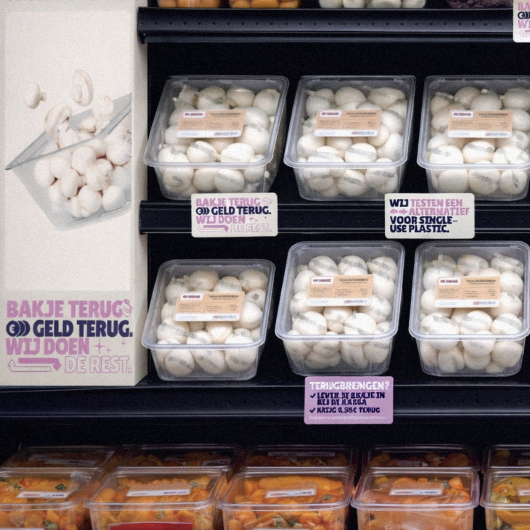
Meanwhile, reusable packaging is beginning to expand beyond foodservice. In Belgium, the REPASYS pilot project is exploring how standardized, reusable mushroom containers can operate across multiple retailers under real-world conditions. The initiative brings together manufacturers, retailers, and logistics partners to better understand consumer participation, returns, and operational feasibility.
Looking ahead
The future of reusable packaging is unlikely to be defined by a single technology or a one-size-fits-all model.
Some organizations will succeed with simple deposit-and-return systems. Others will benefit from RFID tracking, QR-code platforms, or more advanced digital tools. The right approach depends on the environment, operational requirements, and user behavior.
What is becoming increasingly clear is that successful reuse requires collaboration. Manufacturers, technology providers, washing partners, logistics specialists, venues, retailers, and consumers all play a role in keeping packaging in circulation.
At deSter, we believe reusable packaging should be designed to fit the ecosystem that best meets a customer’s needs. Whether that system is simple or digitally enabled, the objective remains the same: reducing waste, extending product life, and helping organizations move toward a more circular future.
Every reuse journey is different. Contact us to discuss your goals and discover which reusable packaging system could work best for your operation.